April 5th, 2019
Happy April! Praise God March is over, because that month felt like a lifetime with all the COVID-19 news. For this weeks blog I have decided to investigate T-cell therapy. In my Microbiology class we are talking about the immune system and its various components. My teacher, Dr. Cramer, went on an aside about T-cell therapy and dendritic cell therapy as treatments for various diseases and health issues, like cancer. This sparked my interest, so I decided to make it the topic for my blog this week.
What is CAR T-cell Therapy?
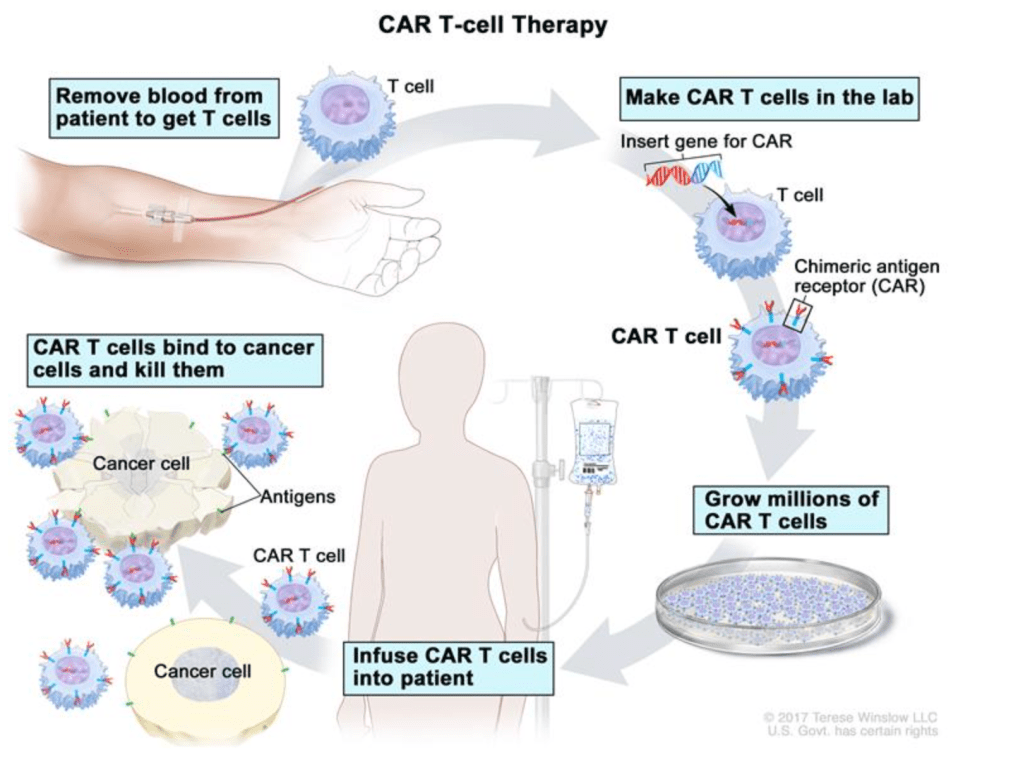
CAR T-cell therapy, which stands for Chimeric Antigen Receptor T-cell therapy, is a treatment options for cancers that originate in a type of immune cell, called a B-cell. The two approved drugs are Kymria and Yescart. Kymria is used on young children to adults age 25 or less who have a B-cell precursor acute lymphoblastic leukemia (ALL). Yescart is a treatment option for adults who suffer from diffuse large B-cell lymphoma (DLBCL).With CAR T-cell therapy treatments T-cells are extracted from the patient’s blood. In a laboratory special genes, called CAR genes, are made. These genes make a receptor which will bind to certain cancer cells within the patient. These genes are inserted into the patients T-cells, creating CAR T-cells. These cells then proliferate, so that there are millions and millions of them. The millions of CAR T-cells are then infused back into the patients blood. The goal is for the CAR T-cells to circulate the bloodstream and then bind to the cancer cells. Specifically, these modified T-cell receptors bind to antigens on the cancerous cells’ surface. This binding action triggers an immune response, which results in the death of the cancer cells.
Side Effects of CAR T-cell Therapy
Like with all treatments, there are side effects. I think it is very important to discuss the side effects of treatments as sometimes they can outweigh the possible benefits and it is important to know the risks. With this treatment there are some significant side effects to note. Most of the noteworthy effects are neurological, which include: speech problems, loss of memory, tremors and seizures. Another possible side effect is cytokine release syndrome (CRS). This is a potentially life-threatening inflammatory response, however it less common, but also a concern. Scientist believe that these side effects occur by the CAR T-cells’ release of substances called cytokines, yet additional research is being done to investigate this hypothesis. Scientist and researchers are continuing to research and attempt to develop a less toxic form of CAR T-cell therapy which will not cause these severe side-effects so that more patents could use this treatment.
CAR T-cell Stats
The following information pertains to the statistics of these treatments based on a study conducted by the FDA:
Yescart: 82% responded to this treatment, with 54% who had a total response. About a year and a half later 40% were still in complete remission (no cancer), showing its long lasting effectiveness. This one-time dose treatment costs $373,000.
Kymria: 53% responded to the treatment, with 40% achieving a complete response. This one-time dose treatment cost $475,000.
I hope you enjoyed this weeks blog post and I hope it provided as a nice distraction from the coronavirus which seems to consume every aspect of our life now. This therapy was very interesting for me to research. I think it is amazing how this treatment is able to manipulate an immune response mechanism to take out these cancerous cells. Further, this treatment is a testament to how far modern medicine has come and where it could go. I really believe that this treatment will continue to lead to breakthroughs in the cancer treatment/cure area.
As always, thank you for reading this weeks blog! I hope you are all staying safe and healthy! Remember to stay inside unless necessary and when in public to practice social distancing!!
 Anna's Microbiology Blog
